100
Knights pursue absolute truth to ensure that their crusades are on firm foundation. Knights must be fully and absolutely certain of this truth—and free of doubt—to be willing to sacrifice themselves or others in the cause of righteousness. This is true for fundamentalist, liberal, and atheist Knights. One cannot kill in the name of ambiguity.
101
Gardeners pursue the deepest spiritual well to ensure that their Garden is grown from a place of profound vision, true divine compassion, and fertility.
102
Knights and Gardeners differ over the origin of religion. Knights tend to argue that religion is revealed—that it was handed down in an already-perfect form from heaven. Gardeners tend to argue that religion is a device—produced through a mysterious interaction of divine inspiration and human ingenuity, the way art is—to help humans understand the spiritual experiences they have, and to inspire human communion with the divine. Both believe that true religion is provided by God.
Atheist Knights, however, in true Knight “either/or” fashion, conclude that if the claims of a religion cannot be proven or are not completely true, then they are completely false.
103
Different aspects of religion are important for Knights and Gardeners. World religions expert Joseph Campbell often claimed that religions serve four functions for humans—and for human societies. When they function properly, religions should (1) invoke an awareness and awe of the divine—the mystical function, (2) explain how the divine has ordered the universe—the cosmological function, (3) show that human society should be ordered like a miniature version of that divinely-mandated cosmological order—the societal function, and (4) help people move through the joys and difficulties of the individual human life—the personal function.
Imagine these functions as four light bulbs mounted to a board, all in a row. For Knights, the cosmological and societal “bulbs” are most important. For Gardeners, the mystical and personal “bulbs” are most important.
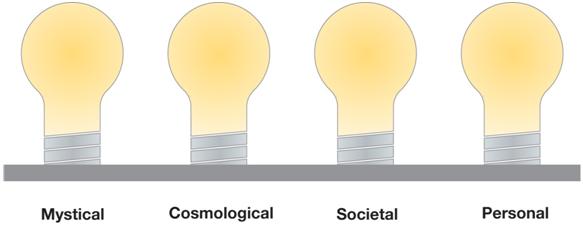 Knights and Gardeners react differently to the loss of a light bulb. Knights defend or try to revive the dead bulb; Gardeners replace it.
How are light bulbs lost? From time to time, cultural, historical, or scientific changes in the world challenges one or more of a religion’s light bulbs so severely those bulbs blow out. When a bulb blows out, that means a reasonable person has trouble believing that the claims of that bulb are valid any more.
Here are two examples. The cosmological and societal bulbs in American Christianity blew out during the 20th century.
- As science (including the theory of evolution) became the primary means Americans understood how the universe is ordered, it fatally challenged American Christianity’s cosmological (“Creationist” or “intelligent design”) claims that the universe was created in a literal seven days as depicted in Genesis.
- Late 20th century developments like the Sexual Revolution, the birth control pill, and decisions by more Americans to delay marriage fatally challenged American Christianity’s societal taboo banning premarital sex.
Today the societal bulbs in other religions are being challenged as well. For example, the caste system—Hinduism’s societal bulb—is in decline in India.
Religions die when their mystical bulbs go out. However, the mystical bulb does not appear to be in jeopardy in any of the major world religions today.
The loss of a religion’s light bulbs does not necessarily mean the death of a religion. As Joseph Campbell also often said, just because a light bulb goes out does not mean there is no electricity.
104
Gardeners do not feel threatened when one of the four light bulbs blows out. They conclude that, since the bulb is merely a device—and a self-contained one at that—only the device failed, not the religion. Gardeners seek to replace the bulb with another that retains integrity to the religion’s original or core tenets.
- Some American Christian Gardeners have reconciled the Genesis account of the universe’s creation with science through broad assertions such as that God created the universe to operate by scientific rules—not all of which we understand yet.
- And some American Christian Gardeners are quietly concluding that, in the wake of the death of the taboo banning premarital sex, God intends a broader sexual ethic. This ethic argues that sexual relationships—between married or unmarried couples—are intended by God to be taken seriously, to be committed and long-term, and dedicated to the mutual care and growth of the couple. (This ethic would also apply to homosexual relationships, especially since homosexuals are not legally permitted to marry in most of the United States.)
105
Knights often conclude that the loss of one of the four light bulbs must be the result of an attack on the bulb by outside forces. Often Knights assert that these attacking outside forces are motivated by self-interest or have been deceived by Satan or a malevolent ideology designed to destroy society.
Knights conclude that nothing is wrong with the device—after all, God created it perfectly—therefore outside forces must have broken the bulb’s connection to its electrical power source. In response, some Knights remove the bulb and probe the socket with pliers. But since the divine “electricity” cannot be turned off, these efforts to restore the connection can shock the user and short out the rest of the bulbs—and the religion’s credibility.
For example, the two bulbs most important to Knights—the cosmological and societal—have largely gone dark in American Christianity today. As a result, fundamentalist Christian Knights have gone to great lengths to repair or defend those dead bulbs. Those efforts, however, can make Christians—and Christianity—appear ludicrous to secular American society.
- A group of fundamentalist Christian Knights, “Answers in Genesis,” resist American society’s use of the theory of evolution to understand natural history. The organization has founded the “Creation Museum” to argue that humans and dinosaurs coexisted. To do this, the museum includes displays of dinosaurs wearing saddles for human riders.
- Some conservative Christian Knights, in an effort to restore the societal bulb (or rather, the taboo on premarital sex) call on unmarried believers to resist all sexual urges, including toward masturbation, in books like Every Young Man’s Battle and programs like “True Love Waits” which requires a pledge of sexual abstinence until marriage.
- Some Christian Knights opposition to divorce and homosexual marriage are efforts to defend or revive the failing societal bulb that represented the heterosexual, nuclear family.
106
Some liberal and atheist Knights claim religions are designed by the powerful as mechanisms of social control. While this has sometimes been the case, efforts to control human behavior this way are more rightly understood as abuses of a religion’s societal bulbs. Religions are meant to invoke divine awe, not enforce divine order. These Knights also overemphasize the importance and role of the societal bulb in relation to the other three bulbs of religion.
107
Christian theologian Bernard Loomer once said “We are born into mystery, we live in mystery, and we die in mystery.” He meant that religion will always be insufficient to render the divine and individual human existence fully understandable—they are too vast, deep, and diverse to explain rationally.
This sentiment frightens religious Knights because they fear it means that the presence of mystery means that God is not sufficiently known, that God’s moral rules are not sufficiently known, and therefore the mapped-out steps to reach heaven are untrustworthy. These conclusions cause Knights great anxiety since they fear ambiguity. As a result, Knights resist mystery within their own faiths—and don’t like it in others’ faiths, either.
This resistance to mystery is not limited to religious Knights. Religious or atheist, conservative or liberal, Knights see mysticism as irrational, unfounded, or dangerously naive. Furthermore, atheist Knights’ beliefs are often upended if or when they have spiritual experiences—their absolute certainty in the absence of a divine, or even something beyond the tangible, is shaken.
Loomer’s sentiment, however, consoles Gardeners, who see religious mystery as evidence of the unending robust ineffability of God—that God is far bigger than our theologies. For Gardeners, far more at ease with ambiguity, the presence of mystery indicates the presence of God.
As our rational approaches to religion continue to break down—and no rational explanation about the divine will ever be sufficient—we become far more aware that there is a deep mystery within the tangible, understandable world. For some this invokes a great dread; for others it invokes a staggering sense of wonder.
108
Today the mystery of the divine and the individual human life is more apparent to more people than ever before. Why? It’s the fault of the anthropologists. Anthropology, in practice, is the study of someone else’s culture. For over a century, university anthropology departments have sent one of their own to study, say, an isolated tribe living in a far part of the world. These anthropologists would admire the tribe’s explanations of why the rain falls, who God is, and how families and societies should be arranged. The anthropologist would say to themselves, “How quaint. They’ve created this entire worldview and religion for themselves that is really quite beautiful. It’s not true, though—what we believe is true—what this tribe believes they made up.”
Later, this anthropologist would return to the university lecture hall and describe the tribe’s beautifully-crafted explanations of how the world works, who God is, and the rest. Afterwards the anthropologist, while walking to lunch, would smack himself on the forehead and think, “Oh my gosh—maybe we created our culture and religion, too.”
Everyone who has access to global media or the Internet has the potential to encounter the same realization as anthropologists have been having for decades. As a result, people are increasingly concluding—not that all beliefs are relative or all beliefs have equal value—but that our beliefs and cultures—and partially our religions as well—are created by people.
More precisely, people today are concluding that religions have layers—and that the “surface” layers are created by people, but the sources of each religion are not.
The three layers are:
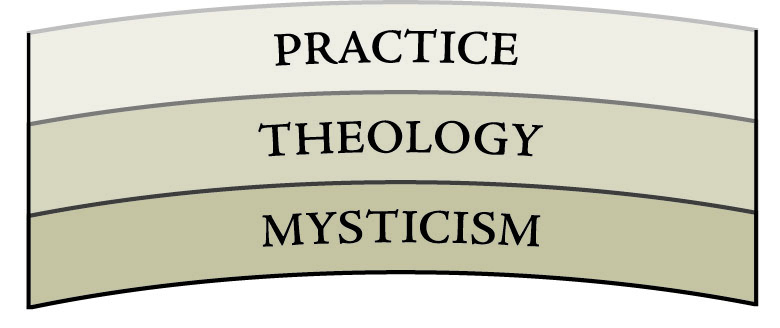
Mysticism, the deepest layer, represents the origin of human religious experience and source of human religions. The experience of the love of God and movements of the Holy Spirit resides at this level, as does the muse of inspiration for artists, poets, musicians, writers, theologians, and intuition for scientists. Unnamable, undefinable, and utterly intangible, this is the experience of the Beyond in our midst
The founders of each of the major world religions had an encounter with the divine—an experience of true Mysticism. These founders—Jesus, Moses, the Buddha, Mohammed, and others—attempted to share these profound mysterious revelations with followers who were slow to understand. Jesus, unable to define or intellectually describe what God revealed to him, chose artistic means–parables about the nature of the divine, and way of God–to communicate those spiritual truths. The Buddha, in what is considered the founding sermon of Zen, simply held up a flower and said nothing. Only one of the Buddha’s followers understood what the silent sermon meant. To a lesser degree, music, art, and literature—regardless of whether it tries to render a religious “point”–attempts to illuminate a mysterious, perhaps Mystical aspect of human experience or existence.
Some of these founders’ early followers created rituals in an attempt to help others emulated the initial Mystical experiences of their religion’s founders, and have experiences of their own. Early Christians, for example, created rituals of baptism and communion to emulate—and hopefully invoke a fraction of—the spiritual experiences of Jesus’ baptism and the disciples’ communion with God during the Last Supper.
Again, Knights are uncomfortable with the free-form spirituality at this level; Gardeners welcome it.
The Theology layer is next closest to the surface. The Theology layer ties those early rituals and beliefs about God into narratives or other contexts to make the Mysticism more tangible and more easily understood by believers. The Theology layer contains all our beliefs about God rather than our experiences of God.
Some Knight theologians create long logic trains to “prove” their arguments about how God works, and how the divine relates to humanity. The broadest efforts to formalize these arguments are referred to in Christianity as “systematic theology”—a study required by clergy-in-training in seminaries. The narrowest version of these efforts is called “apologetics.”
Knights today—both liberal and fundamentalist—clash over whose Theology is finally and absolutely correct. This clash has partly driven the culture wars of recent decades.
Gardener theologians also craft organized views of how God relates to humanity, but these views are less concrete and feature fewer “non-negotiables”—they allow for more mystery. Gardeners are often less attached to the Theology layer—and do not fight over it—because they believe there is Mysticism beneath. They understand that the map is not the territory.
The Practice layer consists of all the ways we live out these beliefs about God. This layer includes how we design our church buildings, arrange the pews, what times we hold worship services, and all our criteria for what we consider morally and spiritually acceptable.
Put another way, Mysticism is the pure water of God’s Spirit. Theology congeals or gels Mysticism to make it more “grasp-able” for people. Practice freezes the Mysticism into ice, making it solid, easily understood, and free from uncertainty.
Reformations happen in religions when they revisit the Mysticism layer of the religion, and question the foundations of the religion’s reigning ideology in the Theology layer. Surface changes, such as embracing “contemporary worship” styles in Christian churches, do not a Reformation make—they are merely like changing the hub caps on a car.
109
There are two ways of being religious today—the exoteric way and the esoteric way, according to Walter Truett Anderson in Reality Isn’t What It Used to Be. Knights tend to pursue the exoteric way. Gardeners tend to pursue the esoteric way.
The exoteric way asserts that God can be found via the absolute truths of doctrine and dogma. The exoteric way asserts religion is a pursuit akin to science—a search for a hidden, provable, unassailable, objective truth. The extremes of the exoteric way can be found among the world’s religious fundamentalisms.
The esoteric way, by contrast, asserts that God can be found via mysticism—a communion with God. The esoteric way asserts religion is a pursuit akin to art—a search for something that serves as a mysterious window to or resonant expression of the divine. After all, the Spirit moves in mysterious ways. The extremes of the esoteric way can be found among the contemplative and celebratory religious traditions such as the Christian monastic orders, Zen Buddhism, Sufi traditions within Islam, and among spirituality-driven artists of all sorts.
In short, the exoteric way finds divine truth via dogma while the esoteric way finds it via mysticism. If the exoteric pursues the “law of God,” the esoteric way pursues the “awe of God.”
Of course, practitioners of each way can misunderstand and misrepresent the other. Exoteric practitioners often say esoteric practitioners have built the house of their belief on unstable foundations, and esoteric practitioners often say that exoterics are like diners who go to a restaurant and eat the menu, as Joseph Campbell often said.
Every religion contains both the exoteric and esoteric ways but emphasizes one or the other. Highly esoteric Christian and Buddhist contemplative orders adhere to exoteric disciplines, and exoteric fundamentalists still sing esoteric hymns.
In exoteric religious practice, dogma rules—spirituality serves the dogma. Since the exoteric way is a search for perfect dogma (absolute truth), esoteric mystical spirituality is only considered valid or trustworthy if it leads someone to believe in that perfect dogma. If it does not, that esoteric spirituality runs the risk of being condemned as dangerous or heretical. This was part of the Pharisees’ problem with Jesus—the spirituality he sparked in his followers did not reinforce the validity of the dogma of the day. In many exoteric Christian worship services today, “praise choruses” (new hymns that sound like rock music) are popular. Though the music is esoteric, the lyrics tend to be very exoteric, and designed to reinforce particular dogmatic faith beliefs.
In esoteric religious practice, spirituality rules—dogma serves the spirituality. Since the esoteric way is a search for revelatory art—ways to express or understand something about the divine, or human relationship with the divine—dogma is only useful and trustworthy if it provides conceptual devices that spark or guide a spiritual journey. If dogma fails to do this, it is abandoned as ineffective. For example, Christian, Buddhist, and Sufi Islamic contemplative orders often adhere to very strict religious practices, but the goal of those exoteric practices is to spark and guide esoteric spiritual journeys in their practitioners.
The exoteric/esoteric difference helps explain why Americans do not attend churches in the numbers they once did. Most Christian churches in the United States emphasize the exoteric way, but Americans increasingly seek an esoteric relationship with God, and cannot find a path to that relationship through churches. Instead, they often turn to music, art, nature, and books. Often they go to bookstores to seek spiritual help before they consider visiting a church. Sometimes they conclude churches don’t have much to do with God any more—if they ever did in the first place.
Theological and artistic movements that successfully renegotiate the balance between the exoteric and esoteric emphases in their religions likely will pioneer their religion’s growth in the 21st century. However, highly exoteric believers will assert that emphasizing the exoteric even further is the most appropriate way to respond to 21st century challenges, and highly esoteric believers will say the same about emphasizing the esoteric.
Both the exoteric and esoteric ways are necessary for a religion to remain healthy. A religion that becomes too exoteric becomes rigid, shallow, and cruel to believers and unbelievers. A religion that becomes too esoteric lacks the focus necessary to generate spiritual maturity or wisdom.
Both ways are necessary for another reason. The span of a human life will require both spiritual ways at different times. Imagine the individual life as like a long attempt to cross a river. Each person will need the (esoteric) skill to swim through sometimes chaotic water—and will need the occasional (exoteric) stone upon which to rest.
110
While moderns search for facts and absolute truths—quests of a Knight—“postmodern” people search for mysticism, adventure, and community—Gardener quests. Some Knights claim “postmodern” thinking and new ideas and cultural shifts are departures from the absolute truths they believe they have already discerned accurately and perfectly.
The Search for Mysticism: Because postmoderns find the Theology layer to be mostly a human creation, they seek instead the Mysticism that inspired those Theologies in the first place. Rather than being satisfied with possessing an absolute truth, postmoderns find the Mysticism layer to be more trustworthy, and spiritually fulfilling. Postmoderns pursue communion with God rather than beliefs about God.
The Search for Adventure: Because postmoderns find the world too big, too complex, and too wonderful and mysterious to explain through rational means, they seek stories that help them grasp the ineffable, as well as their place in the world. On this point, Christianity is well-positioned to offer spiritual wisdom and solace to postmoderns because over 80% of the Bible’s contents are stories.
Postmoderns seek several kinds of stories, (1) narratives that open them up to the Mysticism layer, and (2) narratives that help them understand where they came from (tradition-stories), where they are today situationally and spiritually (map-stories), and where they are going (vision-stories).
The Search for Community: Because many postmoderns live in a world where institutions, political priorities, social crusades and even family relationships come and go, they do not become too attached to them. Rather, they search for other places to invest their loyalty and energy. Simply put, postmoderns are not loyal to what they can outlive. Instead, postmoderns invest themselves in their community, friends, and family (however defined)—the things they find most immune to change. Postmoderns stick with the people who will be with them through all of the world’s changes rather than with the things or ideas that change. For postmoderns, “family” is who loves you, not necessarily who you are related to.
111
Knights find mysticism dangerous—intellectually and spiritually. Knights seek “laws of God”—timeless, unchanging facts about God to prove God’s existence, order society, and that lay out a reliable path to heaven. Knights often work to codify and arrange those “laws of God” into systematic theologies—canons of absolute truths, correctly understood and interlocked—and defend those systems using a form of argumentation called “apologetics.” Put another way, religious Knights design their theological arguments like engineers and architects design buildings.
Imagine this process as like the construction of the naked superstructure of a skyscraper reaching up to heaven. Knights lay a strong concrete foundation based on the fundamentals of their form of faith, and then select steel girders based on their most sound theological arguments to build the superstructure. As the superstructure reinforces itself and reaches higher toward heaven, Knights feel safer and more confident they have discerned absolute truth correctly. However, if a new factor appears on the scene that points out flaws in the arguments that give those foundations and girders strength, Knights panic because they conclude their understanding of God must be flawed—and they fear that means that they cannot reach heaven. Like a flawed building, if a Knight doubts his or her faith superstructure, his or her faith in God can utterly collapse.
This phenomenon is not limited to religious Knights—Knights within the scientific community do it as well. However, since science is a process of inquiry it has flexibility—“absolute truth” about how the universe works changes every few years as new evidence comes to light and new theories are developed. The superstructures of science are designed to be replaced and repaired; superstructures based on religious fundamentals are not. Because of this, superstructures built by religious Knights can be fragile.
Further, religious Knights are prone to a particular form of self-deception called reification. Reification is the human tendency to invent a notion about God—then forget that they invented it—and conclude it is an absolute truth about God. A small example is the Sunday morning worship service in many Christian churches. These churches sometimes say that worship services should take place at 11 a.m. on Sunday mornings, as if that were God’s holy intent. This practice is a human creation designed to make churches more available to people. Years ago American churches began holding worship services at that time because it was between the times farmers milked their cows. Today, many churches mistake an old practice based on convenience for an actual intent of God. All people are vulnerable to this phenomenon. Knights’ superstructures often consist of many foundational beliefs and theological arguments that are reified items rather than actual absolute truths.
Knights will go to extremes to defend their faith superstructure from other faith-based or secular challenges. If possible, Knights may simply ignore the challenges, new information, or changing world, or say these new aspects are not relevant. However, when Knights cannot ignore the new challenge they will attempt to counter the threat with superior argumentation. This is the goal of the practice of apologetics.
When Knights encounter an onslaught of threats to their faith superstructure, they may withdraw from society, retreat inside their superstructure, and fortify themselves against the world. In conservative American Christianity in recent decades this has resulted in, for example, the establishment of Christian schools and contemporary Christian music market as an alternative to their “sinful” counterparts. It is also the reason why many Knights fear their children will learn to challenge their faith superstructure in public, secular schools and thus become victims of “too much schooling” or “bad education.”
If Knights can’t fit an aspect of the world into their faith superstructure, they find it threatening or “wrong.” Since Knights perceive the world as a battlefield between divine good and demonic evil, they associate anything outside their faith superstructure as part of that demonic evil. Some Knights simply fear the world.
Many Knights can become anxious and exhausted as they try to believe the entire contents of their faith superstructure—hundreds of rules and dozens of arguments—and believe it perfectly, without a shadow of a doubt. They fear that if they fail, even a little, God will not allow them into heaven. Similarly, they fear that if society does not perfectly conform to God’s requirements, it will collapse into selfishness, lawlessness, and Satanic rule. For some Knights, holding the correct beliefs in your heart, and defending one’s heart from evil thoughts requires constant vigilance.
- Some Knights’ faiths do not survive challenges to their faith superstructure. Dr. Bart Ehrman, a scholar of early Christianity and author of Misquoting Jesus, was raised a fundamentalist Christian, and graduated from Moody Bible Institute—a prominent fundamentalist college. Taught to revere the Bible, Ehrman continued his education into how the Bible was written, recorded, and passed down through the ages. As his education and research progressed, Ehrman was exposed to evidence that overwhelmed and destroyed his belief that the biblical text was factually inerrant. Without that foundational belief—the most critical aspect of the faith superstructure he was raised to believe—Ehrman’s faith collapsed. In true Knight “either/or” fashion, Ehrman concluded that if Christianity was not completely true, then it was completely false. Though Ehrman lost his faith, he remained a Knight in worldview and perspective. He now considers himself an agnostic. Ehrman’s early faith superstructure was inadequate to cope with the challenges of the world around him.
- Al-Qaeda found challenges to its faith superstructure so threatening, it decided to go to war with the world—meaning the West, Israel, and any other form of Islam. They see so many threats around them that they claim there is a “world war against Islam.” Most al-Qaeda senior and operational leaders were trained not in madrassas (Islamic religious schools) but in the sciences. Again, religious Knights design their theological arguments like engineers design buildings, and al-Qaeda senior leaders reflect that pattern. Osama Bin Ladin was an executive in his family’s engineering company. Ayman al-Zawahiri was a medical doctor. Mohammed Atta, leader of the 9/11 cell, was a civil engineer. Atta’s faith superstructure was so rigid (and the man so unlikable) that Atta’s roommate in Hamburg, Germany put up a poster of the Muppet “Miss Piggy” in their kitchen. The roommate knew Atta would find the image of a woman—and an assertive one made of pork—deeply objectionable. Al-Qaeda is engaged in a war with the world because they believe an Islamic world rooted in a faith superstructure other than their own is incorrect and will be doomed to subservience to the West and Israel. (It’s worth noting here that al-Qaeda’s version of Islam is nothing like the Islam practiced almost everywhere in the world. Most al-Qaeda members have a very rudimentary understanding of their own faith. Even al-Qaeda’s most publicly prominent “religious scholar,” Abu Yahya al-Libi—first trained as a chemist—possesses Islamic theological training perhaps only equal to a bachelor’s degree.)
- By contrast, psychiatrist Walker Percy’s faith in science collapsed when his own superstructure based on empirical science failed. During the 1950s, as Percy finished medical school at Columbia University, he contracted tuberculosis from a cadaver. During those days, the treatment for the disease included complete bed rest in a sanitarium retreat setting. During one of his sanitarium stays, Percy and the Catholic patient in the next hospital bed engaged in long debates over the adequacies of empirical science, including psychological theory, to understand the human creature—or God. Percy, unable to defend his secular superstructure, became a Catholic philosopher and novelist. One of the main themes in his writing was the limits of human understanding—in either faith or science—to apprehend the mystery and scale of the divine or the ordinary human existence. His first novel, The Moviegoer, won the National Book Award in 1962. Percy’s life as a Knight broke down, and he became a Gardener. But no matter how many accolades Percy received, and how many Christians found Percy’s writing helpful spiritually, he was dogged his entire life by complaints from religious Knights who said that if he were a true Christian he would write comforting, uplifting, superstructure-confirming novels like the Left Behind series.
Knights find mysticism—and anything that might lead to it—spiritually threatening. Gardeners do not. For Knights, iconoclasm (or postmodern deconstruction, which is similar) leads to nihilism—it destroys faith. For Gardeners, iconoclasm and postmodern deconstruction leads to mysticism because it breaks through the human creations of the Theology layer—it simplifies faith.
Knights fear the loss of their superstructure; they worry they will lose their faith as a result. Gardeners do not. Gardeners understand that superstructures are human creations just as light bulbs are.
112
Gardeners believe mysticism aids one’s communion with God. Most Gardeners do not need an elaborate faith superstructure to believe in God or get to heaven—merely a few spiritual and theological “seeds” to grow on. They are not anti-superstructure; they just understand superstructures as devices or tools rather than absolute truths.
Gardeners understand that the spiritual truth of a situation can be larger than its literal truth. For example, many of us have seen a teenager ask a combat veteran what war is like, and the veteran finding himself utterly unable to express the truth of what war is. The veteran often simply says nothing. Spirituality can be like that, too.
Novelist Tim O’Brien tried to express the veteran’s dilemma in his short story “How to Tell a True War Story.” In the story he tells the tale of two buddies in his platoon in Vietnam—Curt Lemon and “Rat” Kiley. One day on patrol, Curt Lemon stepped on a land mine and was blasted into a tree. He was killed instantly. The next day the platoon entered a village, and in the middle of the village there was a baby water buffalo tied to a stake. Rat Kiley walked over to the baby water buffalo, stared at it for a moment, then shot its ears off, then its nose, and tail. Then he shot out its knees and it fell to the ground in agony. He continued to pick off flesh with each shot, but the beast would not die. So Rat and several other soldiers threw it down the village well where it finally passed away.
Often, when Tim O’Brien tells this story at author signings, an elderly lady will come up to him afterwards and tell him what a sad story it was, how badly she felt for the baby water buffalo, and what an awful war story it was. O’Brien says he never has the heart to tell these ladies that it’s not a war story; it’s a love story. It’s the story of how Rat Kiley loved Curt Lemon so much that he could not handle it when Curt died. The loss was so great that Rat behaved horrifically.
In reality, O’Brien writes, Rat did not maim a baby water buffalo—there was no water buffalo. Rat was simply very quiet for a few days. O’Brien knew, though, that writing what literally happened would not convey the depth of Rat’s mourning, so O’Brien created the baby water buffalo story to express the truth of what Rat was going through. In essence, O’Brien created a fiction—a literal untruth—to express a spiritual truth.
Gardeners do not believe something has to be literally true for it to be spiritually true. This means that Gardeners do not become too attached to particular faith superstructures—they know that God resides beyond them all, and that when one light bulb (superstructure) blows out, God will shine through via another one. Because of this, Gardeners tend to be more comfortable with uncertainty and ambiguity when it comes to faith—they know it keeps them spiritually advancing rather than remaining merely spiritually advanced.
Frederick Buechner once wrote that the most useless faith-related phrase today is “There is God in the highest,” asserting that “There is mystery and meaning in the deepest” is better for beginning conversations about faith. He meant that rather than presenting a faith superstructure for people to accept or reject, Christians should invoke in others a sense of mystery, of mysticism, because the subsequent journey leads to communion with the divine.
Gardeners do not root their faith in beliefs about God, or a perfect superstructure—or even in a mere feeling about God—but rather in an unspeakable sense of God.
113
Knights’ adventure stories—and organizational mission statements—cast Knights as participants in political or spiritual war campaigns, business competitions, showdowns with evil, last-ditch survival efforts, or missions to slay a political or cultural dragon. They pursue visions of victory—or the safety for Knights and their loved ones—that results from vanquishing a foe or a threatening trend.
Gardeners’ adventure stories—and organizational mission statements—cast Gardeners as participants in construction of something new, on a journey to a new spiritual place, or aiding the creation or rebirth of a community. Sometimes these are stories of transformation of individuals (making “born again people”), places (making “born again communities”), or churches (making “born again churches”).
114
Knights often cast their communities—and churches—as Noah’s arks (providing safety from a dissolving world), lighthouses (serving as symbols of hope that the entire world is not yet lost to evil), firebases (from which to launch spiritual warfare campaigns), or military academies (for preparing Knights for lives of spiritual combat). Knight communities—and churches—are usually hierarchical and consist of two classes—champions and those who support (or aspire to be) the champions. The purpose of Knight churches is to rescue people from evil. Knight churches can show world-changing initiative, be aggressive, or be aggressively paranoid.
Gardeners often cast their communities—and churches—as architects, construction crews, hospitals, nonjudgmental resting places, salve, liberators from guilt, schools, platform builders, or spiritual seed beds (which is what the word “seminary” means). Gardener churches can also show world-changing initiative, but may emphasize education over action when focused too inwardly.
115
For Christian Knights, God is the Great, High King whose glory is vast and strikes awe into the believer. For Knights, God’s greatest attributes are strength, power, and knowledge of perfect righteousness. For Knights, the power of the Kingdom is found in the strength of the righteous. Blessings of creativity from God are meant to be used to help win the conflict against evil.
Knights idolize Jesus, who was martyred, the Apostle Paul, who was persecuted and imprisoned by an evil world for his beliefs, and Stephen, who was stoned to death for refusing to recant his Christian beliefs. They also idolize the warrior Christ facing down shrieking demons in Revelation.
For Knights, religion is intended to reveal the existence of God to an ignorant world, and to provide a pathway to proper devotion, moral living, and life after death.
Knights sometimes pray, “Lord, give me the strength to resist or overcome evil,” or “Please, Lord, make me as steadfast as a stone.”
Among Knights’ favorite hymns are “A Mighty Fortress Is Our God,” “Onward Christian Soldiers,” and “Lead On, O King Eternal.” Most “Christian rock” and “praise choruses” used in worship services are Knight songs.
116
For Gardeners, God is the Great Spirit, the Ground of Being, the Beyond in our midst, the Source of all breath, life, and joy.
For Gardeners, God’s greatest attributes are infinite imagination and creativity. Human creativity represents mere shadows of God’s infinite creativity, and are meant to be used to grow God’s Garden ever more. For Gardeners, the power of the Kingdom of God is that of fertility, not of control.
All “seven signs” of Jesus’ divinity in John’s Gospel are those of a Gardener. In this gospel, Jesus (1) furthered a celebration of life by turning water into wine at the wedding in Cana, (2) healed a nobleman’s son, (3) healed a crippled man, (4) fed the five thousand, (5) calmed his disciples’ fears by walking on water, (6) restored the blind man’s sight, and (7) raised Lazarus from the dead.
For Gardeners, religion is the proverbial finger pointing toward the moon, something that points toward the true divine Spirit, not an absolute truth in and of itself.
Gardeners sometimes pray, “Let God’s love energies fall on me,” “Show me what Garden needs to be grown here,” and “What is your mystery and meaning here?”
Every U2 song is a Gardening song.
117
“Amazing Grace” is a favorite of both Christian Knights and Christian Gardeners.
118
For Christian Knights, the purpose of salvation is to rescue sinners from sin. Knights spread the Gospel to rescue sinners from the clutches of evil and spread the rule of virtue throughout the world. Once saved, these new believers are expected to participate in the crusade. Knights interpret their perceived enemy’s actions as malevolent and aggressive and conclude they have no choice but to defend themselves—and save the innocent and the entire world from that aggression.
For Gardeners, the purpose of salvation is to restore sinners to the spiritual growth process.
119
When a Knight’s faith is shaken, he or she wonders Was the truth… wrong? What am I fighting for? Am I on the right side?
When a Gardener’s faith is shaken, he or she wonders Am I doing the best thing? Have I grown an unneeded or wrong crop? Have I built the wrong thing? Have I wasted my time? Have I grown a monster?
120
Knights breathe easy—and yearn for the day—when the war is over, all foes have been defeated, and the world has been made safe. They dream of kicking back in a rocking chair on their front porch, putting their feet up, and looking out over a quiet, green meadow in the evening cool.
Gardeners breathe easy—and yearn for the day—when the garden is growing, the rain is coming, and the day’s honest work is done. Just as Knights do, they dream of kicking back in a rocking chair on their front porch, putting their feet up, and looking out over a quiet, green garden in the evening cool.
121
There are more Gardeners in the world than Knights.
122
There are many wars; there is one Garden.
What Now? (Afterword)
Every futurist has a master plan to change the world for the better. This book is part of mine. This book is a building block I am providing toward the creation of a better future. It’s a training tool to help you think like a futurist. The world needs better futurists—and more of them. You can help.
The future is the realm of the Gardener. The more long term one thinks and behaves, the more one functions as a Gardener. Thinking about the future, enabling it, and planning for it are always Gardener endeavors. The future cannot be “won” for any one party, group, nation, or religion. Instead, the longer term we think, the more we realize we can only enable good futures to emerge by building robust capacities for people to solve problems we cannot yet foresee. My hope is that this book creates a future-enabling capacity in people’s minds by drawing the distinction between dualistic and problem-solving orientations in a way that produces a “meme” (a contagious idea) or a “metaidea” (an idea that enables other ideas to arise).
Other futurists work to build capacities to create better futures. For example, there’s a group of futurists that are building a clock that will keep time for 10,000 years, what they call “The Clock of the Long Now.” Figuratively speaking, the Clock will “tick” once per year, “bong” once per century, and the “cuckoo” will only come out once every millennium. (You can learn more at www.longnow.org or in Stewart Brand’s superb book The Clock of the Long Now: Time and Responsibility, Basic Books, 1999.)
One of the project’s members has joked that he wants the group to sell wristwatch-sized versions of the Clock because the Clock changes how you think about the passage of time. He says he plans to wear the Clock wristwatch on the opposite hand from his normal wristwatch. Put simply, on your normal wristwatch, time belongs to you—you decide what you will do with this hour, this day, this year. On the Clock wristwatch, however, you belong to time. And that realization sparks a more profound life question, What will be my contribution to the 10,000 years? In this book’s parlance, the question is What will be my contribution to the Garden?
What’s yours?
Note to 11
This kind of dualism in the Old and New Testaments—and depictions of angelic good and demonic evil—is the product of Zoroastrian influence on the writers. This influence is most clear in the books of Daniel and Revelation. These books follow the basic Zoroastrian religious narrative that the physical universe is the site of a great war between a God of Light and God of Darkness and their followers—the Sons of Light and Sons of Darkness. In this religion, Zoroaster is the savior figure, who dies and returns—now named Zarathustra—at the end of time to lead the Sons of Light in a great final battle against the forces of darkness. A Zoroastrian text was found among the Dead Sea Scrolls.


 The Knight and The Gardener